Double feature

In an effort to clear the backlog of theater posts, I thought I’d double-up.

* * *
LA+1
I caught performance artist/musician/raconteur Laurie Anderson’s latest show, Delusion at the Brooklyn Academy of Music before it closed this past weekend. I like her work and have seen her a few times. If you want to watch something really fun, find a copy of her 1986 film Home of the Brave.

I went with J, who is a big Laurie Anderson fan. We both enjoyed the show but as we were walking out of the theater into a cool, autumnal Brooklyn night, J made a very astute observation. It was entertaining, but it was pretty much the same stuff that Anderson has been doing for years and years. The material was fresh, but the delivery vehicle was the same. It was a lot of voice modulated story-telling and poetry, some multimedia presentations and an amplified electric violin that’s run through a processor. Don’t get me wrong; it’s all great stuff, be we’ve seen it before.
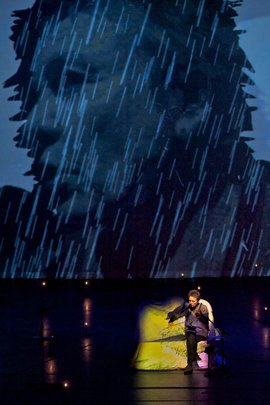
LA+4

Actually, I suppose you could say the same thing about the Rolling Stones. Or Jack Nicholson. Or Charles Dickens. Or. Or. Or.
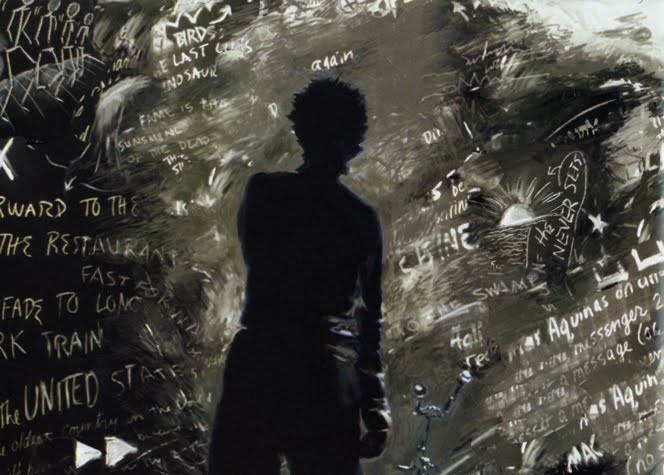

LA+3
* * *
MWP
I’m not a huge George Bernard Shaw fan but I quite liked the revival of Mrs. Warren’s Profession at the Roundabout. Women had it rough in 1893. Your choices were boiled down to either marrying someone wealthy, even if they were hideous and you didn’t love them or, as Mrs. Warren did, open a string of classy whorehouses in Europe. The show was deemed obscene when it first opened (of course) but since then people have come to see the truth in it.

Mrs. Warren is played by Broadway veteran and 24 alumni Cherry Jones. (She played the President on 24.) It’s a perfect tough broad performance that is suited to her temperament. I’d love to see Meryl Streep in it someday. The role of the combative daughter is played by Sally Hawkins, who was so adorable in Mike Leigh’s Happy Go Lucky. I’m not sure if young Miss Hawkins has a lot of stage experience but I, along with a few people I spoke to who saw the show, thought she was able to stand toe-to-toe with Jones which, I can assure you, is no small feat. The reviews came out this week and as hard as the actors worked, they were mixed. That’s show biz.
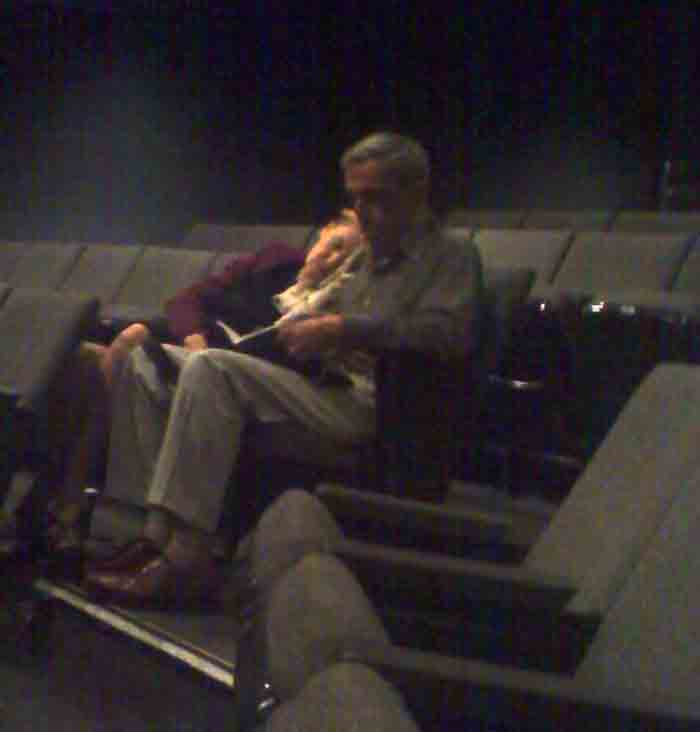

More effective than Ambien at quadruple the price

I’ve seen lots of people fall asleep at the theater. It happens all the time. Sometimes, people eat a heavy meal before the show. Or they’re not use to staying up so late. Or it’s a 3+ hour Shakespearean marathon. Other times, the material is so weak that it can’t hold your attention. You sitting in a nice, cozy, dark theater. You’ve had a long day. What’s happening on stage isn’t very interesting, so you might as well take a little nap. It’s okay. Just don’t snore. That rude!

But it’s an entirely different story if you fall into such a deep slumber during the first act that you actually sleep through the intermission and continue to doze through the second act. That’s when you’ve got a real problem on your hands.

LA

Notice all the empty seats?

Such is the case with the Roundabout’s production of The Language Archive currently in previews. The second act was actually pretty interesting. It had some nice, dreamy fragments that worked and a satisfactory conclusion. But by then, it didn’t matter. It was too damn late. It’s like a car that was driven over a cliff and on the way to the bottom of the ravine, the driver decides she’d like to turn around.

main_imgThe first act was a lumbering grind. I mostly blame the playwright, Julia Cho. The dialogue is stilted and stiff. It didn’t sound like people talking to one another. It sounded like actors reciting pre-rehearsed lines. There were a lot of false pauses. And it wasn’t the fault of the poor actors.

At the same theater last season I saw Dana Ivey in The Glass Menagerie and it was the polar opposite of this. The dialogue flowed smoothly. It sounded like spontaneous, natural conversation.

And beat me over the head with a big metaphor bat. He studies languages but he can’t talk to his wife. I get it. His lab assistant can’t confess her feelings for him because she has a problem communicating. Yet, she works in a language lab. Oh, the irony! The old bickering couple have a secret language that can only be used when they’re able to communicate with each other. I get it. Okay?

This thing is directed by Mark Brokaw, who knows his shit. Sometimes, the material just doesn’t come together.

Next.

* * *

Favorite spam email subject line of the week:

Naked pictures of Gwyneth Paltrow will give you iron, man.

Tee-hee.

The Mahster Thespian

This isn’t the first show I’ve seen this season but it damn sure is the funniest. The revival of David Mamet’s A Life in the Theatre is still in previews. I’m not sure how the critics are going to treat it but I had a great time.

life

Patrick Stewart is a pretty amazing actor. In addition to his big, fun paydays as Captain Picard and Professor Xavier (the same character, really), he’s an accomplished Shakespearean stage actor. I saw him a few years ago in London in Antony and Cleopatra, which was good, and two years ago as Macbeth in New York, which was great. I thought he was too old to play Macbeth but he pulled it off.

Here, he plays an old windbag of an actor who has spent far too much time backstage and not enough time with civilians. Overly dramatic and sensitive to criticism, he takes himself and his craft far too seriously. His young colleague, played by T.R. Knight from Grey’s Anatomy, suffers his tantrums, hurt feelings and long, long, looooonng soliloquies about the theater and life, but develops a real affection for him. Some of the scenes are only a few lines long, but they’re perfectly placed little comedic bombs.

On the surface, Mamet seems to be making fun of actors. But the play is actually a love letter and a big wet kiss to the profession. It’s got a beautiful ending. As he walks off the stage, Patrick Stewart, in character, repeatedly, and with great hammy flourishes, wishes a good night to the imaginary audience he’s been playing to. Finally, just as he’s about to disappear into the wing, he turns to the audience, breaks character and quietly says, “Good night.” It’s an unexpected, effective fourth wall moment.

Written in 1977, this is one of Mamet’s earliest plays. Do you know how Woody Alan’s early stuff is a lot funnier than his later stuff? That goes for Mamet, too.

Back to the Garden of Eden

I see faces and traces of home back in New York City.

Back in N.Y.C.
Peter Gabriel

I might do a another post or two about my trip to Cleveland but for now let it be known that I’m back in New York. My siblings and nieces are in Cleveland, my wife and kids in New Jersey, but New York is my home and it feels good walk though Times Square again.

* * *

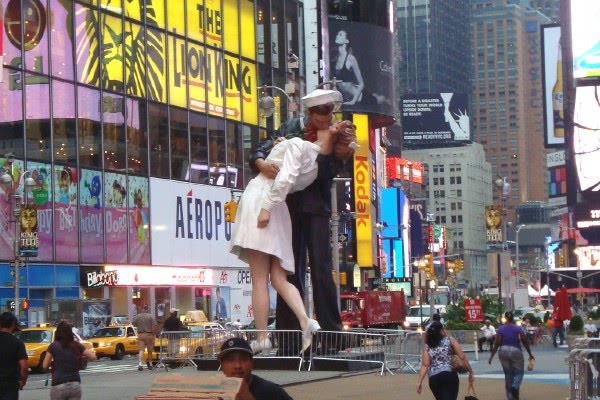
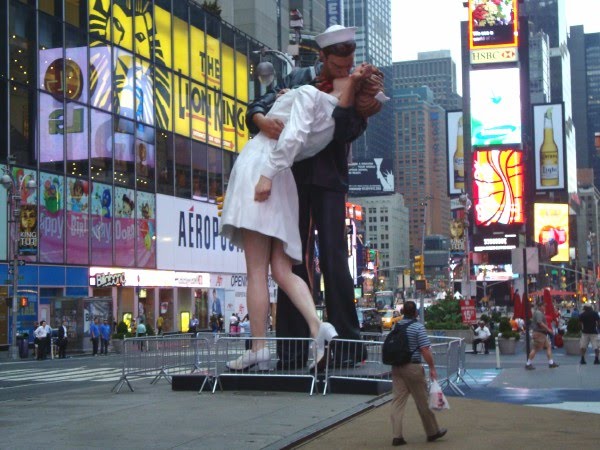
This giant (26 ft./8m.) bronze sculpture is Unconditional Surrender by Seward Johnson. It’s up through August 16th. How fun is that!

ts+1

ts+2

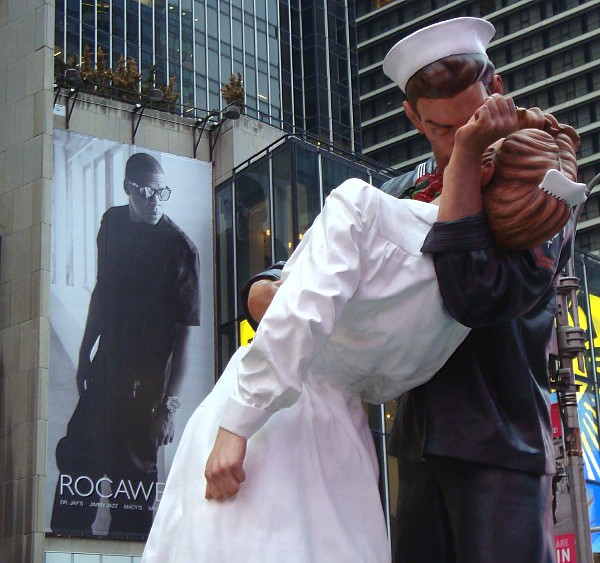
It’s a replica of the famous photograph taken by Alfred Eisenstaedt of a sailor and nurse kissing to celebrate the end of World War II. It was taken on August 14th, 1945—65 years ago tomorrow.

vj-day

This angle makes it look as though Jay-Z is eavesdropping on a private moment.

ts+3
* * *

It’s not often I’ll see a play twice. There are too many out there and my funds are too limited to double-up on something I’ve already seen, but I made an exception last night for David Mamet’s Race. It’s due to close next week and I really wanted to see it with its new cast. As much as I enjoyed the first viewing, this second night was even better. The original cast did a great job, but I think the new cast is an improvement.

raceAd with original cast

James Spader was replaced by Eddie Izzard. I’m a huge fan of Izzard and I’ll see anything that guy does. As good as Spader was, Izzard was even better. His delivery had more punch and he seemed more at ease in his role of an attorney caught up in his own prejudices. And he seemed much more comfortable prowling the stage.

David Alan Grier was replaced by Dennis Haysbert (of 24). Again, Haysbert had better command of the role. Kerry Washington was replaced by Afton Williamson, who I saw last year in August Wilson’s Joe Turner’s Come and Gone. Her’s was an angrier, grittier performance. Richard Thomas is a holdover from the original cast. After so many months, he has a sharper focus on his character, a clueless, wealthy, white man who stands accused of raping a black girl. Is he guilty? Can the truth be found with her red sequined dress? You have to draw your own conclusions.

I checked my notes and although I’ve seen several plays since April, this is the first full-blown Broadway production I’ve attended since then. It was nice to be in a big house again. Have I mentioned that it’s good to be back?

The King lies bleeding with his throat slit

henryI struck gold the other night. This is why I persist in chasing these small productions. I wish I were a better writer so I could do justice to these guys. Here’s how they staged the last scenes. Hang on.

It’s nearing the end of the War of the Roses. Having cut King Henry’s throat, Richard (who will eventually become Richard III after much violence, bloodshed and treachery) stands over him, knife in hand, thinks of his two brothers who are the only thing standing between him and the crown, and says with a malevolent grin:

I can smile and murder whiles I smile.

Henry lies at his feet, face down, in a crumpled mass. A thin trickle of blood starts from high in the theater rafters and drizzles on the King’s back. (Now THAT’S hitting your mark.) A small pool forms on his garment and then begins to puddle around him. All the while, Richard is spinning his evil intent.

The final scene takes place in the court of the newly crowned King Edward IV. He orders a celebration and gives a rousing speech assuring the kingdom that the long years of war are finally over and that they stand on the cusp of peace and prosperity. During the celebration, King Henry is still upstage and the blood continues to trickle and pool around him. The cost of that peace is made graphically clear.

Then, the court clears, the lights dim, the scene changes and Richard bounds out from the back of the theater, mad and naked, hides behind the overturned throne and recites a few lines from the Now is the winter of our discontent… speech that begins Richard III, effectively linking these two plays.

The blood stops flowing. The play ends. The cast comes out for their curtain call. Everyone except for Henry. He’s still lying on the stage in his own blood. The crowd files out and Henry never moves. Nervous laughter from the departing audience. Fucking brilliant.

This was Wide Eyed’s production of King Henry VI, Part III. It’s in a small, black box theater down on 13th Street and 3rd Avenue. The entire production was one, long (3:15) holy shit. There’s a guy named Ben Newman who played Richard who was so effective that I wouldn’t want to meet him on the street. Also, props to Nat Cassidy as Henry, the King who never wanted to be King and Justin R.G. Holcomb as the Earl of Warwick. Who are these guys? Three unknowns who don’t deserve to be.