I’ve been a bit preoccupied with the Thunder Road chapbook, hence no new blog posts. Do you miss me? I miss you. Worldwide distribution is out of my office next to the family room. People have started to receive their copies and here are some nice things they’ve said about it. Copies are still available. Hint.
Here I am at Lead Graffiti lettering the hardcover copies.
* * *
I received the book today, thanks for the quick delivery!
I have to tell you, the pictures don’t do it justice. What a beautiful design, from the BTR typeface to the raised lettering…simply gorgeous. I’ve been a Springsteen fan for three decades and this has to rank up there with some of the best Bruce-related items I’ve collected over the years. I feel very fortunate to be one of the lucky 200. And of course Nick’s passionate and lovingly written essay. That it’s personally signed is quite the bonus. This will sit well with the 1st edition copies of some of my all-time favorite books and I know I will revisit your hard-won labor of love often.
* * *
In my hand…
…is a thing of absolute beauty. Wow. My book arrived today, and I’m floored… even more beautiful than expected.
* * *
Got the book yesterday and it is a beautiful thing. I really love it. Especially enjoy the black on black and white on white cloud prints. Adds a beautiful subtle layer to it all. The yellow against black is super and the letterpress text looks really nice. I kept noticing it while I was re-reading the essay.
I love the song Thunder Road, and Nick Hornby’s essay just nails it!! The song is corny, overwrought and bombastic but I still love it. Like great art the song as a whole manages to create a set of emotions beyond its words.
* * *
Additionally, the nice people at Indie Reader.com found out about the book via Nick Hornby’s Facebook page and wrote a feature story that (as of this writing) is on their landing page.
* * *
Speaking of Nick, I received this after he opened his box o’ books that included his hardcover inscribed to him by Bruce:
They came! They look really, really lovely, and I’m thrilled. I’m so glad you stuck it out…
Respect,
Nick
* * *
I told Nick that his hardcover is the ultimate association copy and if it ever appeared at a rare book auction, it would ignite a fierce bidding war.
Once again, I am too lazy to write individual posts for these plays so I decided to lump them together. We are all better off for it.
* * *
Through a Glass Darkly is a stage adaptation of a 1962 Ingmar Bergman film. Cheery, it ain’t. But Carey Mulligan, who was so good in An Eduction, gives such a powerful and convincing performance as a woman who is descending into mental illness, that I’m actually quite worried for her. I don’t know how she can put herself through that wringer eight times a week for eight weeks and come out the other side undamaged. When I left the theater, I was actually upset and had to phone Mrs. Wife so she could talk me down.
Part of what makes this so effective is that it’s playing in a small, off-Broadway venue in the East Village and everything is RIGHT IN YOUR FACE. You don’t feel the detached protection that a big Broadway house offers. Not to be missed but not for the meek.
* * *
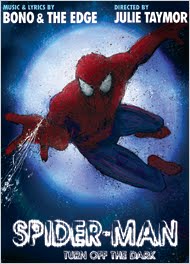
What to say about Spider-man: Turn off the Dark? It is not good. The friend I went with saw an early preview and he said that it has improved insofar as it now has a coherent plot (albeit the same tired Spider-Man story I’ve been reading since I was a kid). Apparently, prior to being shut down, it was a confused mess of junk.
Some of it was quite stunning to look at from a design standpoint and the costumes were fantastic. Julie Taymor’s influences were pretty obvious. The actors wanted it to work so bad but it didn’t. And I’ll tell you whose fault it is:
Bono and The Edge.
Those guys should stay the hell off Broadway. The music was AWFUL. Each song was one boring funeral dirge after another that dragged the show down. Songs would start and I couldn’t wait until they were over. That’s a major problem if you’re trying to stage a musical. 2:35 long and there were exactly two—that’s TWO—songs that didn’t work like a 50-pound stone strapped to the actors’ backs. And, yet, the crowd gave a standing ovation. I don’t get it.
* * *
Mark Ryalnce is the current man of the hour in New York theater. What a tough, funny performance. Jerusalem is three hours of pure adrenalin rush. There was some concern that this London transplant was too “British” for a U.S. stage. (Whatever the hell that means. Shakespeare is pretty British and he does just fine.) Rylance is Johnny Byron, local seducer of disenfranchised youth. Firmly anti-establishment and not one to respect the rules, he pays for his rebellion in a most violent way. My toes curled back to my heels. Hope they perform a snippet of the torture sequence on the Tony Awards this Sunday.
* * *
Check all your razors and your guns
We gonna be rasslin’ when the wagon comes
I wanna pigfoot and a bottle of beer
Gimme a reefer and a gang o’ gin
Slay me ’cause I’m in my sin
Slay me ’cause I’m full of gin
Needless to say, I won’t be bringing the daughter to see this one. The Devil’s Music: The Life and Blues of Bessie Smith is less play and more musical review. There are some brief biographical interludes but it’s mostly one great blues song after another. A sax. A stand-up bass. An upright piano and one strong voice belting out songs from the early blues era about love and sex and cheating and drinking. Kind of like country music today.
* * *
Robin William was great for two reasons. First of all, he wasn’t Robin Williams. He altered his voice, look, posture and body movements to become someone who isn’t quite so recognizable. I dispensed with the preconceived notions within a few minutes. Second, he’s being used as bait. His name is above the title but he is not the lead. More like the third or fourth, actually. The actors who drive the show are committed, believable characters. So people are drawn in to see Robin Williams and what they end up with are solid performances by actors who otherwise wouldn’t get this kind of exposure. And that’s a beautiful thing. The play is rough stuff. Lots of war and blood and mysticism and ghosts and talking to God. I liked it a lot.
* * *
Oh, let’s see Play Dead! It’ll be a funny, spooky night out in Greenwich Village. Ha ha. So fun! It’s just a magic show!
Okay. There were a couple of moments in this show that were so genuinely frightening that if the lights had been on, I’d have run screaming out of the theater like a little girl. Creepy old Todd Robbins got together with the magician Teller and created a show that is definitely for adults only. In more than one segment they turn out the lights. They somehow received permission from the City of New York to also turn out the exit sign lights, so that you are plunged into a pitch-black darkness. The he starts telling gory stories.
I’ve just spent the last several days basking in the unexpected tsunami of congratulations that followed my post about the Thunder Road chapbook I helped publish. All I wanted to do was tell a story and sell some books, but the kind words that were left in the comments section and included with the orders I received were a complete surprise. What a treat!
Let’s see…there are about 48 comments right now and in order to appease my pathetically needy ego, I’ve probably read each one no fewer than five times. That means I’ve read and reread about 250 comments. What an utterly shameless waste of time. I approve!
Included was a clever quip from Nick Hornby which, I suppose, is as close as I’ll get to the :15 minutes of fame that Andy Warhol promised me, and a remarkably gracious comment from my buddy, Jim, who started this project with me all those years ago. Although things kind of imploded along the way, there wouldn’t have been a book without him. Truth.
Thanks to those who have already submitted orders. I beg your patience, as I am a one-man worldwide fulfillment center. So far, I’ve gotten orders from all over the U.S., Denmark, Canada, Australia and England. (Now that I look at the list, I realize they are from the epicenters of lily-white Caucasian culture. Springsteen and Hornby’s base!) Also, I’m shouldering a 40-hour work week and have two young daughters who feel they own all my free time. I wonder where they got that idea? And thanks to all who provided links, especially whoever put it on Backstreets.com. My hit rate went from a measly 80-90 per day to a fertile and potent 475 per day.
* * *
Did I just write a post about a post? Now, that’s just lazy. I’ve got posts about New York City in the queue.
And by “I,” I mean “WE,” because there’s no way I could have pulled off a stunt like this on my own.
Back in 2003, I took a class in book binding and letterpress printing at the Center for Book Arts in Manhattan. I had been collecting for quite some time and began to wonder, as most collectors eventually do, how books are constructed. Especially the fancy ones.
That same year, British author Nick Hornby published Songbook. It’s a series of essays about songs that are meaningful to him. It’s still in print and it’s a pretty entertaining read. I’m a big fan of his work and have a healthy collection of signed first editions and rarities.
Songbook includes an essay on Bruce Springsteen’s Thunder Road that I think is particularly effective. It’s the standout piece of the book. I was in bookbinding class stabbing myself with a sewing needle trying to perfect a chapbook spine stitch when I had the spark of an idea. Wouldn’t it be cool, I thought, to create a chapbook that married both Hornby’s Thunder Road essay with Springsteen’s lyrics? And do it legitimately, with permission from the artists? Yeah, right. Like that could ever happen.
* * *
I bought a rare Charles Bukowski first edition from Jim, who lived in Phoenix, Arizona. As it turned out, he’s a letterpress printer. He creates beautiful, limited-run books at synaestheia press. He’s a design and production genius. I was a patron of his press and we became pretty good friends. He visited New York City, I visited Phoenix and we also met in Las Vegas once. We spoke all the time.
I told him about my crazy idea for the Thunder Road chapbook. He encouraged me and said that if I could somehow secure permission from Hornby and Springsteen, he would print it. Shortly thereafter, Hornby was on a promotional tour for Songbook. At his Manhattan stop, while getting my copy signed, I casually asked if I could reprint his Thunder Road essay in a chapbook. Much to my surprise, he said yes, with the stipulation that every penny made from the sale go to charity. That was okay by me, since making money never entered my mind. Not once!
Now the tough part. Bruce Springsteen’s business machine is fiercely protective of his material. I thought that going to him with an agreement from Hornby already in-hand would add legitimacy to the project. I wrote to his manager, Jon Landau, and not long thereafter, much to my complete shock, received permission to reprint the lyrics on a letterpress broadside. The stipulation was the same as the one Hornby set out for us; we were not permitted to profit from the venture. All proceeds had to be donated to charity.
We received nothing more than a verbal agreement and a “good luck” from Hornby, however, we received a multi-paged contract from the legal department of Shore Fire Media that we were required to sign and return. It was stipulated, in no uncertain terms, that all monies were to be donated to charity and that we were to use the lyrics provided with the contract (vs. getting them off the internet and possibly misquoting). Pretty serious stuff. The contracts were signed on May 28, 2004.
With my recently acquired knowledge of chapbook construction, I worked up about four different prototypes. The trick was to collapse both the essay and the broadside into one book. I sent them off to Phoenix and, if I’m being completely honest here, the layout ideas that Jim came up with were much better than mine. I wanted the book to be great so it required some humility on my part. The finished layout is probably 80% his talent and 20% my lucky guesses.
Do you know what can dramatically increase the value of a book? A signature. We had another brilliant, impossible, idea. We would fly to London, meet with Hornby, and he would sit and sign a stack of title pages for the essay portion of the book. In early 2006, I sent him, via his publisher at Penguin, a “Hey, remember me? We’re going to be in the neighborhood. How’d you like to sign some title pages?” e-mail. How many authors of Hornby’s stature do you suppose would entertain such a ludicrous request? Damn few, I’d guess. But he agreed to do it. On March 16, 2006, he had us over to his writing studio and for a few hours the three of us bullshitted about music and literature and the internet and he told us some fun stories about dealing with Hollywood, all while signing page after page after page after page.
We were planning a print run of 200 copies. Hornby signed 250 leaves. This is common practice as it allows for overage, contributor copies and damage during construction. Nick developed a terrible hand cramp. I felt kind of bad. Afterwards, he walked with us back to the tube station and took us past the vintage (1913), now demolished, Arsenal stadium, home to his beloved Gunners. It’s one of my top five favorite afternoons ever.
I sent a request to Springsteen asking if he would be willing to sign a portion of the broadsides. I didn’t dare hope that he’d sign all 250. He declined and I didn’t have the nerve to pursue the issue. Frankly, I was surprised that he granted permission to use the lyrics and I didn’t want to push my luck.
* * *
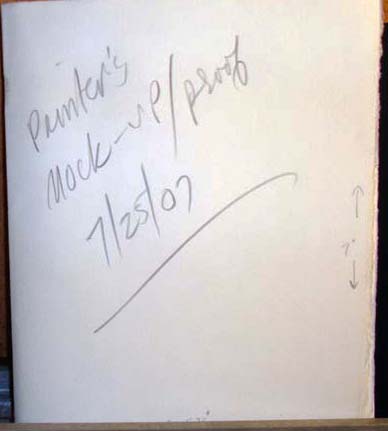
It took a little over a year to produce the printer’s mock-up proof. A year is a bit longer than is customary for this type of work, but there were delays.
And then there were more delays. The months peeled away. I thought the project was becoming a burden, so I offered to find someone else to print it. But Jim is steadfast and a man of his word and always finishes what he starts. The printing commenced slowly.
I don’t recall the specifics (and wouldn’t share them here if I did) but eventually, tensions rose, words were exchanged and we stopped speaking. Our friendship died. And the Thunder Road chapbook project ceased.
In July of 2008 I wrote to Hornby and said that, with deepest regrets, the book would not be made. He wrote a short piece on his blog about how all artistic endeavors begin with good intentions but don’t always come to fruition or a happy ending. He used our book as a case in point.
* * *
Years passed by.
I wrote to Jim last fall and after a few tentative e-mail exchanges, I asked if he wouldn’t mind shipping the guts of the book. He had finished the essays and broadsides but the covers still needed to be printed and the book had to be assembled. He boxed them up carefully and they arrived in New Jersey sometime in December.
* * *
I had some contacts in the letterpress community that led me to Ray at Lead Graffiti, an extraordinary letterpress printer in Delaware. I approached him about the project with the caveat that although I could cover the cost of materials, all the heavy lifting would have to be done pro bono. Would he be interested?
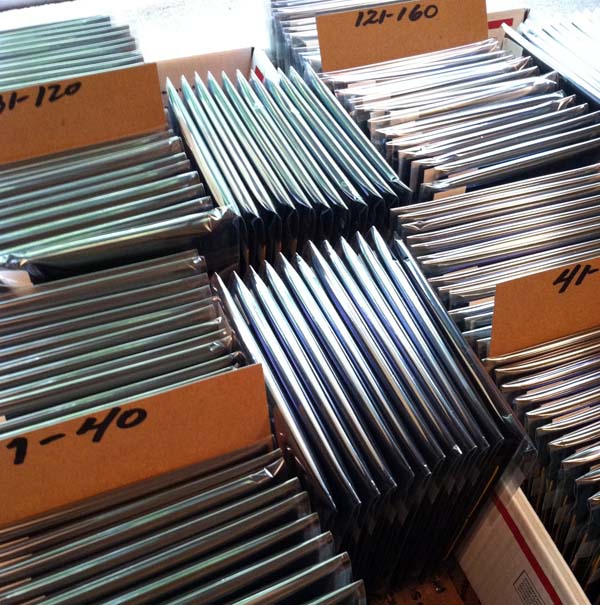
He embraced the project so enthusiastically that in addition to making the 200 softcovers, he decided to create a special run of 26 hardcovers that would sell at a premium. Ray’s partner, Jill, jumped in and created a beautiful linocut stamp of storm clouds to print on the cover.
Here’s Ray slaving away at the printing press.
I was moved by their enthusiasm for the project and willingness to create hardcovers. I meditated on how they could be made even more special. I approached Springsteen again and asked if he would be willing to sign the broadsides for just those 26 copies. He politely declined five years ago, but this time he said yes. I dropped the broadsides off at his house and picked them up several weeks later.
* * *
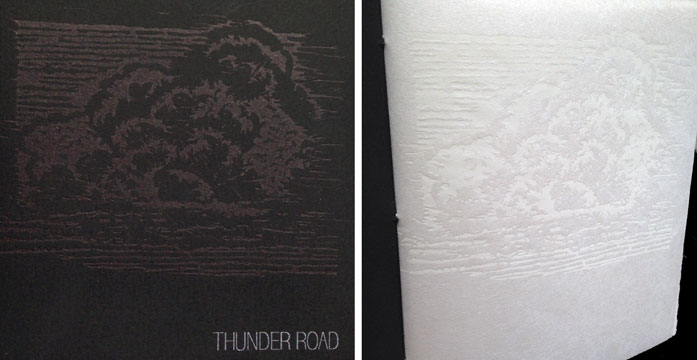
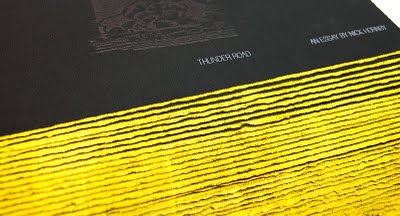
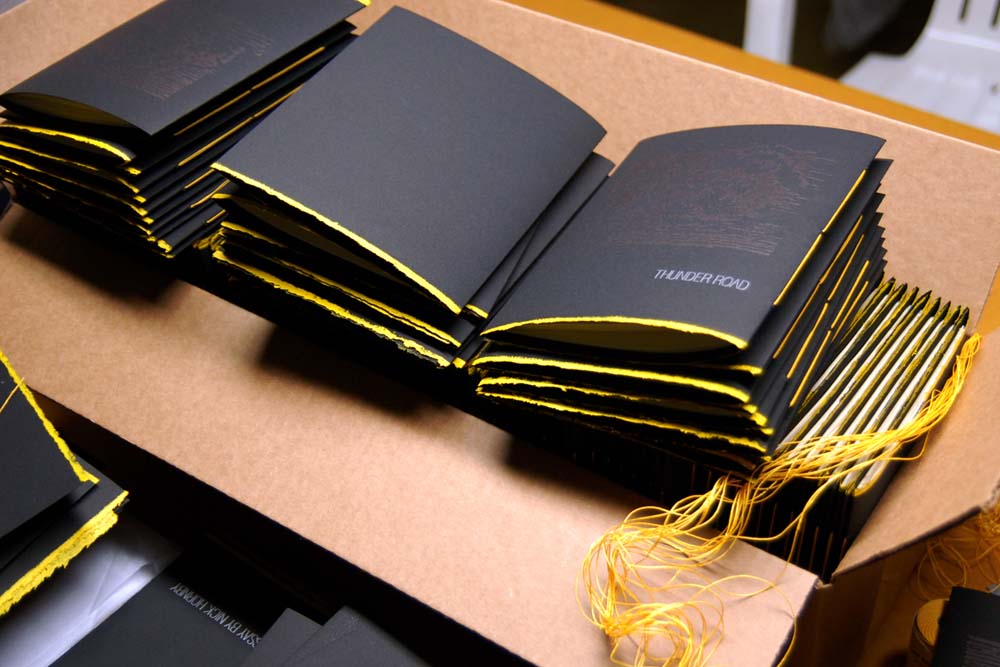
The book has two spines. The essay is bound in on the left spine, and the broadside with the lyrics unfolds from the right. We borrowed the same font from the Born to Run album cover for the title. The covers are printed on black Somerset Velvet and the flysheet for the essay is printed on white mulberry paper.
The linocut is printed black-on-black ink for the cover and repeated in white-on-white for the flysheet.
A hand-rolled deckle edge that emulates yellow road paint was added along the bottom.
It’s sewn with matching yellow thread. The hardcovers have yellow endpapers.
The 26 copies signed by both Springsteen and Hornby were priced at $225 and are sold out. But I still have the softcovers to sell. They are priced at $60 each; a steal considering the level of craftsmanship and the content. All copies are signed by Nick Hornby on his essay. Per Hornby and Springsteen’s request, proceeds from the sale are being donated to TreeHouse, a school in London for autistic children.
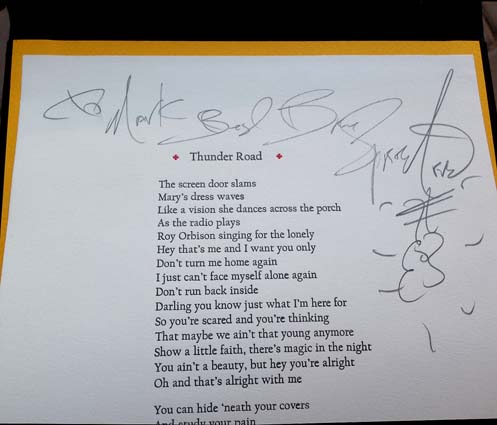
We created six special sets that are not for sale. One hardcover and one softcover are laid into a custom clam shell case, handmade by Bill of Bottle of Smoke Press, who also assisted with the cover printing. These sets go to Springsteen, Hornby and the four project participants. Bruce was kind enough to inscribe the broadsides for those six copies to each of us. Here’s my hardcover copy. Brothers and sisters, this is all the payment I’ll ever need.
* * *
Getting this book made has been a long, arduous process but the finished product is a small masterpiece. Hardbound copies were purchased for the special collection libraries at Columbia University, The University of Delaware and The Newark Library. There’s also a copy on hold for the Library of Congress.
Letterpress printing is a fading art form. There are no new Heidelberg Presses being manufactured. These books are created by craftsmen who are at the top of their game. They’re the polar opposite of cold, impersonal eBooks. Aside from the obvious “do-good” aspect, they are a prestige item. But it was very, very expensive to produce. And I don’t just mean the black Somerset Velvet, white mulberry paper and untold hours of uncompensated labor. This book annihilated a great friendship.
You can order a copy via PayPal. The account is ThunderRoadChapbook@gmail.com. [Please do not leave orders in the comments section.] I’ll start shipping copies sometime next week. If you really want to help out, throw a link up to this too-long post.
Please note: We are sold out. There are no books available. Thanks to all who purchased a copy.
A poem should be written so that a whore, a stockbroker, a garbage collector, an aviator, a jockey, a baker, a child molester, a saint, a fool and a genius can understand it.
Charles Bukowski
If you’re familiar with Bukowski’s work, you know how much he adhered to that philosophy.
That’s the inscription in one of my Bukowski first editions. In this month’s column over at the Undie Press, I discuss Bukowski’s talent for inscribing and also say some unflattering things about a beloved, dead author. Enjoy!
* * *
If you haven’t already done so, click to the comments in my last post and read JZ’s fascinating history lesson. It’s got more gravitas than anything I’ve written here.







 Exile on Pain Street