it isn’t black theater. it’s theater.

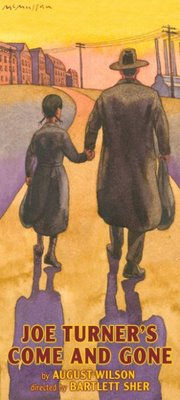
Joe+TurnerAugust Wilson was one of America’s most successful playwrights. His 10-play series, The Pittsburgh Cycle, chronicles the experience of black America through the 20th Century. Each play is set in a different decade. Some characters appear in more than one play. The children of characters in the early plays appear in the latter plays. It’s a bit Shakespearean in scope.

I saw the Broadway revival of Joe Turner’s Come and Gone. It takes place in 1911 during the Great Migration. Recently freed slaves were migrating north to find a new life, causing tension between the white working class and blacks who had already settled in the area.

I saw the original Broadway production way back in 1988 when I first moved to New York. Fortunately, my brain is so porous that I didn’t remember a thing about it, so it was as if I was watching it anew.

I’m afraid that white tourists are going to say to themselves, “Oh, that’s a black play. It’s not for me.” I hope that’s not the case because there are themes of alienation and finding yourself that can reverberate with anyone who has a beating heart. The actors work their asses off to great effect so I hope it finds traction.

spirited evening

I’ve seen many good plays but occasionally you get that rare night when every actor is firing on all cylinders and the material is strong and it’s being performed in a proper old theater.

CB I saw Nöel Coward’s Blithe Spirit at the Shubert Theater. The dialog was fast and clever and it was flying out of the mouths of some of the most accomplished actors in town. The show is in its infancy, just having opened a few days ago, and some lines of dialog were stepped on and dropped but it was a fun evening, regardless.

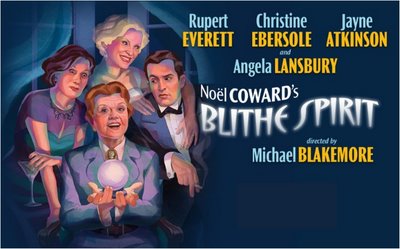
As good as the play is, that’s how bad the ad campaign is. Take a look at this ugly illustration. It makes me not want to see the play.

bs

British theatrical treasure Angela Lansbury played a crazy old medium and Rupert Everett was the spirit-tormented husband. Everett was the big surprise. We thought he was going to be the weak link in the chain but he was terrific.

I like Nöel Coward’s England. His is the England where the sun never set on the Empire and every problem was solved with another round of dry martins. Money was never an issue. P.G. Woodhouse is like that. So is Woody Allen. Money isn’t part of the plot. It’s just there in abundance.

The Shubert is one of New York’s classic original theaters. It was was built in 1913. In the 1930s you could have seen Fred Astaire in Gay Divorce or Katherine Hepburn in The Philadelphia Story. In the 40s you could have seen Paul Robeson, Jose Ferrer and Uta Hagen in a legendary production of Othello. There’s lot of history on them boards.

Mary-Louise Gabler

I saw Mary-Louise Parker (my pretend girlfriend) in the Broadway production of Ibsen’s Hedda Gabler.

hedda1

When it opened a few months ago, the critics were almost unanimous in their disdain so I expected very little. Out loud, everyone says that they don’t listen to the critics—especially New York theater critics. You won’t find a bigger bunch of malcontent failed writers and actors looking to tear down what they themselves could not build. But the truth is that EVERYONE listens to the critics.

I’ll admit that there were a few passages that were…ahhh…what’s the word I’m looking for? Oh, yea. Boring. A few scenes plodded along at too leisurely a pace. But I am pleased to report that, overall, I enjoyed it. Pretend Girlfriend (gawd, she’s cute) was in very fine form in the title role as a bored, depressed newlywed who becomes so despondent over her inability to control the lives of the people around her that she shoots herself in the head at the end of the play. Talk about your desperate housewife!
That fucking Ibsen is a real barrel of laughs, isn’t he? The last time I saw an Ibsen play, Master Builder, I ended up walking out at the intermission—something I had not done in over a decade. I think I’m through with Ibsen. I’ll stick with the Bard and leave the depressed Norwegians for the New York theater intelligencia.

when clowning becomes just another goddamn job


humor1

This is probably a back-handed compliment but I found Humor Abuse, the one-man show at the Manhattan Theater Club, far more enjoyable than I thought I would. If it weren’t for mimes, clowning would probably be the bottom rung of the entertainment ladder so I didn’t expect much.

The premise sounds pretty staid; a lone actor stands center stage and acts out the story of having a professional circus clown for a father. Father drags son into the business. Son learns the trade and tries desperately to please his father. Father ends up burning son. Ho-hum, right?

WRONG! It works beautifully. There were a few truly inspired moments that made me think about my own idiot father. And then I realized that the show isn’t really about clowning at all. Nice work.

10,000 dead frenchmen

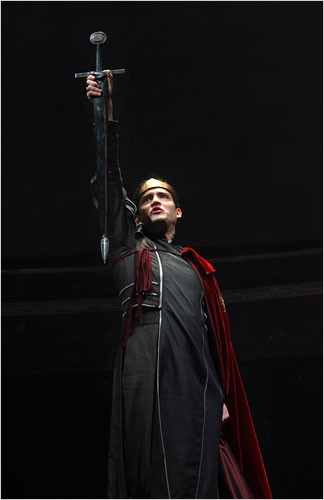
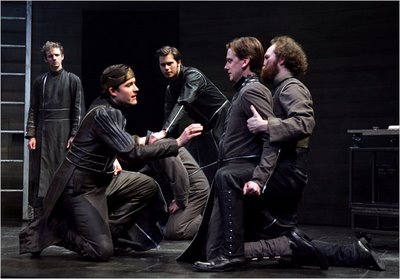
henry+aI treated myself to Shakespeare’s Henry V. It was three hours but they flew by. I loves me the King plays.

When it began, I had my usual wrestling match with the dialog. It takes at least :10 to :15 minutes until I settle down with the cadence of Shakespearian English and acclimate myself to the iambic pentameter. (Whatever the hell that is. If you know, please explain.) It’s like trying to grab a garden hose that’s turned on full blast and is whipping around.

Henry1500

Henry V was one of England’s more successful monarchs. By the end of his rein, he ruled over a united England and France. His son, King Henry VI was a zero who lost everything his father built and started the War of the Roses. What a dickhead.

This play is a home run for an old Anglophile like me. In order to distract King Henry from his plan to liberate the church from a portion of its property and cash, the slippery Bishops (Are there any other kind?) conjured up a distraction. They convinced Hank that he is the rightful heir to the French crown. A war ensued and with a country to invade, who has time to abscond with church property?

Shakespeare’s historical dramas are based in fact. When Henry fought at Agincourt, a hungry and weary English army was outnumbered 10-1 by a fortified French army but England routed France! That’s a fact!

Take that, Frogs.

My comprehension of Shakespeare is tenuous at best. Do you know what helps? Jamming Cliff Notes the day before the play. I do it every time I see a Shakespeare play. Otherwise I’d get lost. I didn’t attend a University after high school so I’m a bit behind on all that stuff.

Henry4650